In collaboration with the Year 12 classes at the Checchi Institute
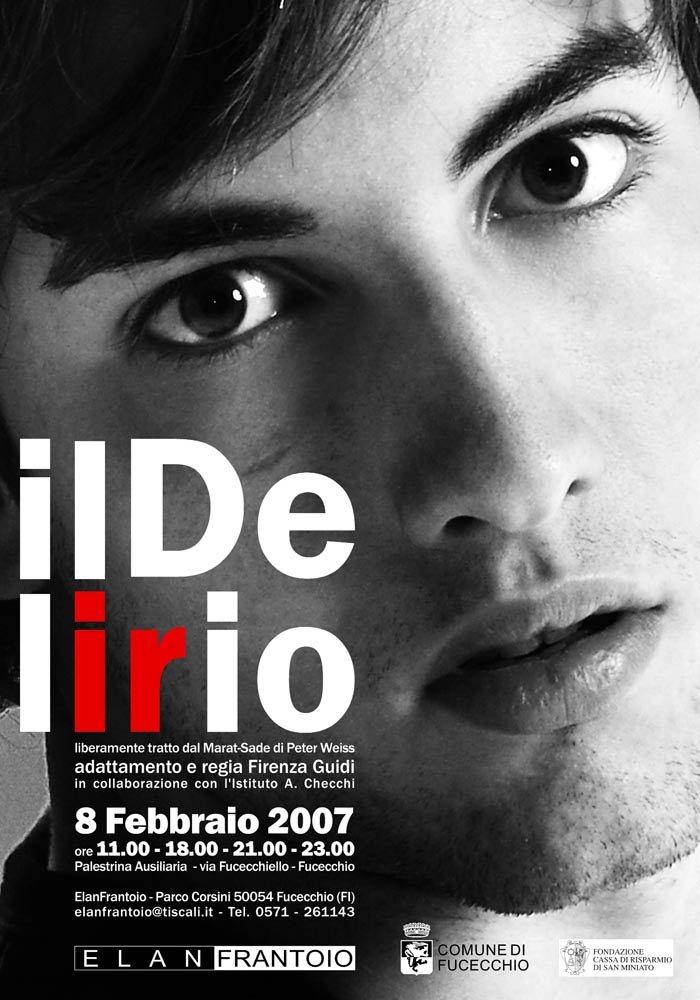
Marat is dead. The Revolution is dead. Within the walls of the Charenton asylum, the auxiliary gymnasium has been transformed into a mortuary where Marat’s wake is being held. The Marquis de Sade, architect of the performance, stands at the door to welcome the audience to his final performance. A pale, emaciated man makes his way through the crowd. A lit cigarette. An intellectual figure. Like all the inmates of this institution, he wears pyjamas and has a number stamped on his arm. He speaks in a feverish voice. He speaks quickly, trying to reach as many people as possible. The ushers notice him and silence him as the audience is led into Marat’s funeral parlour.
From here begins the journey, at once sad and exhilarating, into madness. The audience will be guided along a path that sinks ever deeper into madness, into the corruption of principles and ideals. The inmates of the Charenton asylum do not wear the tricolour cockade on their hats, but instead wear on their arms the star-badge that the Nazis had imposed on the Jewish population. Stripped bare and interned in concentration camps, we, the descendants of these ancestors, ask ourselves: how could this have happened? This is the madness of the wise-mad, of the madmen in power, of the madmen who perpetrate exterminations, of those who decide, through ordinances and decrees, the cold and calculated plan of a holocaust. But madness is also a space of freedom. Thus, Weiss does not have Marat or Sade or Corday speak directly, but rather the madmen who impersonate the historical figures portrayed. Precisely because it is madmen who are acting, their words seem to ring out freer, truer than anyone else’s, free from fear or external constraints. “Among madmen there is complete freedom,” writes Weiss, “one can say very peculiar and mad things, absolutely anything.”
When
08.02.2007
Where
Checchi High School – Fucecchio