Journey/Reading/Chorus/Installation in Memory of the Victims of the Holocaust
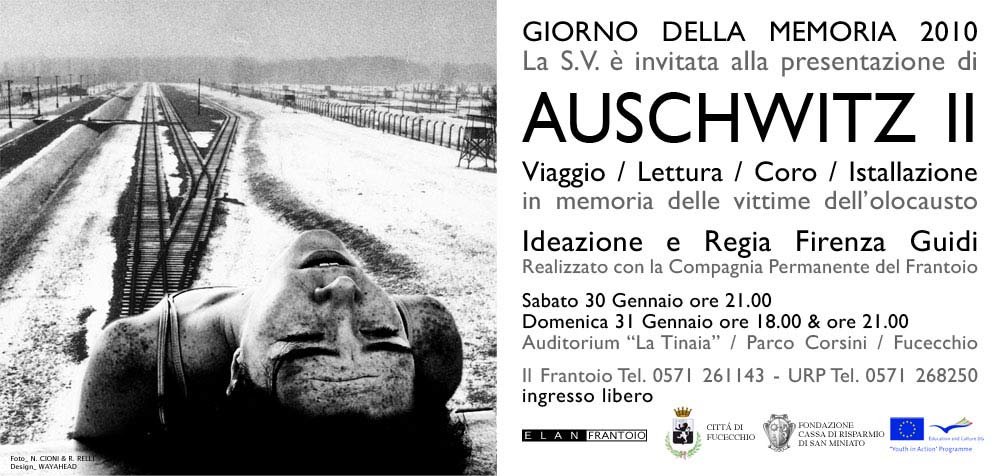
“Work sets you free”: this is the inscription that greeted the deportees at the entrance to Auschwitz. The camp is here, today; the past is knocking at the door, and we have a duty to listen to it, to bear witness. As you cross the threshold of the concentration camp, you are no longer a human being; you no longer have an identity—only a number. Then comes the moment of stripping and shaving; dignity is torn away. You put on the uniforms and become an object among objects; you wander through a timeless world made of piles of hair, clothes, shoes, mountains of objects that once belonged to someone; everything is piled up, every remnant has a place, a use, because nothing from the animal is thrown away. One advances to the rhythm of the march, one has the image of forced labor, grueling, in the cold for hours, endlessly, exhausted bodies in snow that makes dying easy, broken by tortures under which it is easy to give in. Evil is a clear and meticulous mind; nothing is left to chance. It is “The Machine,” a mechanism of mathematical rigor, always in motion, with a thousand eyes, which is everywhere, which calculates everything: a perfect gear with the rhythms of a factory, because the Holocaust is the daily application of simple, monotonous gestures. Guiding us on this journey of terrifying dehumanization is the voice. There is the detached voice of the guide, because first and foremost, we must understand and know with our minds. There is the faint and broken voice of the men and women who lived through the horror, because secondly, we must understand with our senses. And finally, there is the imposing, choral voice of millions of victims demanding to be remembered, because in the face of extermination, our minds must remain vigilant and present, to ensure that it never happens again.
When
January 27, 2010 – February 2, 2010
Where
“La Tinaia” Auditorium, Corsini Park – Fucecchio