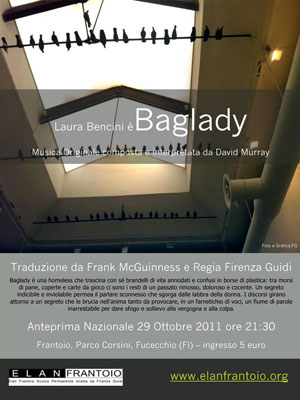
Baglady is a homeless woman who carries with her fragments of her life, tangled and confused in plastic bags: among breadcrumbs, blankets and playing cards are the remains of a painful and bitter past that she has repressed. An unspeakable and inviolable secret permeates the disjointed speech that flows from the woman’s lips.
Her words revolve around a secret that burns so deeply in her soul that it provokes, in a delirium of voices and points of view, a stream of consciousness that, like an unstoppable river of words, breaks through the dams of years to give vent and relief to shame and guilt.
At the beginning of our journey, I imagined Baglady as a ragamuffin: someone who sleeps on cardboard boxes in the cramped basement of a department store, dressed in layers of old boots and jumpers and stuff salvaged from Caritas bins. During my research, I saw Laura in this guise and wasn’t convinced it was the right direction to take. Too easy. Too theatrical. Too familiar. So, during one of the last rehearsals, I asked her if she happened to have a black suit. Something almost elegant. She said, “Yes, I have one I haven’t worn in years. It belongs to a person who no longer exists.” That’s it. It was from this bouclé wool suit with gold buttons that my new Baglady was born. A real woman, not a character from the theatre; a woman-who-could-be-me; a woman who has lost everything but is desperately seeking another kind of respectability; a woman who tries not to cry and whine and complain like a Greek heroine. One who clings to her bouclé wool suit with gold buttons in order to survive and not give up, and to maintain, against all of life’s challenges, her dignity as a woman.