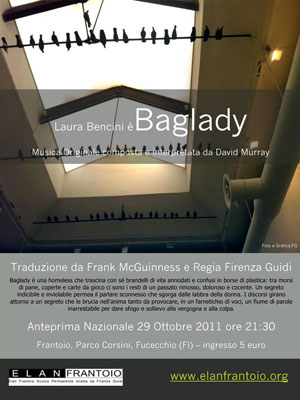
Baglady is a homeless woman who carries with her fragments of her life, tangled and jumbled together in plastic bags: amongst bits of bread, blankets and playing cards lie the remnants of a repressed, painful and searing past. An unspeakable and inviolable secret permeates the disjointed speech that pours from the woman’s lips.
Her words revolve around a secret that burns so deeply in her soul that it triggers, in a delirium of voices and perspectives, a stream of consciousness which, like an unstoppable river of words, breaks through the dams of years to give vent and relief to shame and guilt.
At the start of our journey, I had imagined Baglady exactly as a ragamuffin: someone who sleeps on cardboard boxes in the cramped recesses of a department store, dressed in layers of old boots and jumpers and stuff scavenged from Caritas bins. During the research process, I had seen Laura in this guise and wasn’t convinced it was the right path. Too easy. Too theatrical. Too clichéd. And so, during one of the final rehearsals, I asked her if by any chance she had a black suit. Almost elegant. She said to me – “Yes, I have one I haven’t worn for years. It belongs to someone who is no longer here.” There you go. It is from this bouclé wool suit with gold buttons that my new Baglady is born. A real woman, not a character from the theatre; a woman-who-could-be-me; one who has lost everything but is desperately seeking another kind of respectability; one who tries not to cry and whine and complain like a Greek heroine. A woman who clings to her bouclé wool suit with gold buttons to survive and not give up, and to maintain, against every challenge life throws at her, her dignity as a woman.